Guide
Corporate Event Packages: 8 Lessons for Restaurants and Venues from 2026 Survey Data
Practical package, pricing and booking ideas drawn from Event Captain's 2026 survey of people who plan or book events for their company or organization.
By Kevin Ho 10 min read
In this article
- 1. Give small teams a clear corporate-event offer
- 2. Make the price and the experience easy to understand together
- 3. Make convenience available at more than one budget level
- 4. Present private space as a specific choice
- 5. Build a planning path and a near-term booking path
- 6. Give client-hosting materials a hospitality emphasis
- 7. Keep corporate-event information useful throughout the year
- 8. Qualify the inquiry around needs, then test the offer
- Quick checklist
- FAQ
- Source
An organizer arranging a company event may well be bringing a small team. In Event Captain's 2026 corporate event planning research, 59.2% of people who answered the attendance question selected a typical group of 1–20. That is a good reason to check whether your corporate-event page clearly serves groups that size. It does not mean 59.2% of all events in the market are small.
The central idea is simple: make it easy for an organizer to understand what their team will experience, what it will cost and how to book. Give small teams a clear offer, then adapt service, space and presentation to what the organizer actually needs.
One caveat before the lessons. The survey measured what organizers reported about their habits and preferences. It did not measure the effect of any of these ideas on bookings, revenue or conversion. Treat each lesson as an offer worth testing, not a proven result.
1. Give small teams a clear corporate-event offer
59.2% of respondents selected a typical group size of 1–20 people (1,201 of 2,030 who answered the attendance question). Among those small-group respondents, 73.6% selected fitting a strict budget (434 of 590), 54.9% selected all-inclusive packages (324 of 590) and 15.8% selected an entire venue or private section (93 of 590). These were separate multiple-choice selections, so they do not tell you how many people chose both price and convenience.
The findings suggest a useful offer to test: a recognizable package for a team social, appreciation outing or client gathering, with an obvious way to check dates. Put these details on it:
- The group range you support, plus any minimum group size or minimum spend.
- Food, drink and activity inclusions, listed separately and specifically.
- Duration, available days and any restrictions that really apply.
- Per-person pricing or a clear quote structure, and what the total includes.
- Exactly which area is reserved, whether it is shared or private, and what that separation means.
- A short inquiry asking for date, guest count, event purpose and budget.
Example wording to adapt: "A team outing with food, an activity and clear per-person pricing. Tell us your preferred date and group size, and we'll confirm the options." This is suggested messaging, not language tested in the survey, and the survey does not establish a best package length, day of the week or minimum group size.
In the study: Group size finding Group-size comparisons group_size_comparisons.csv
2. Make the price and the experience easy to understand together
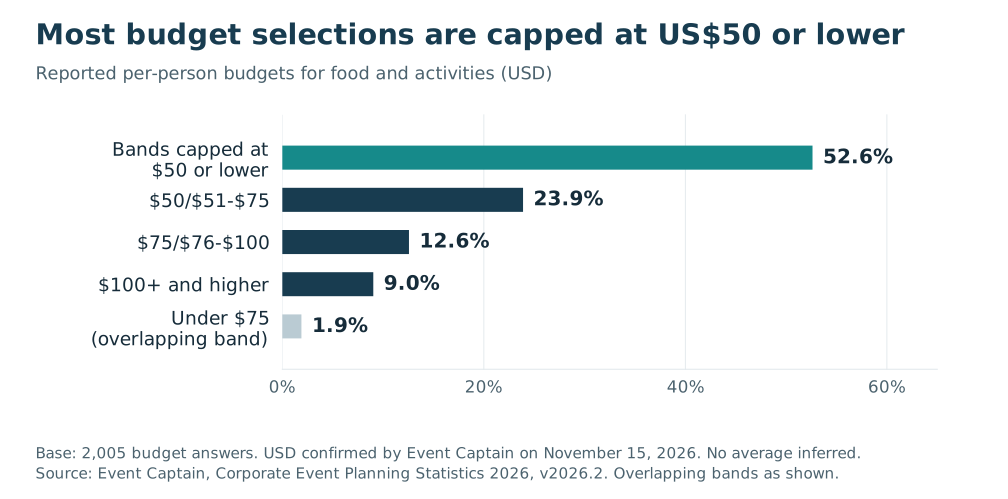
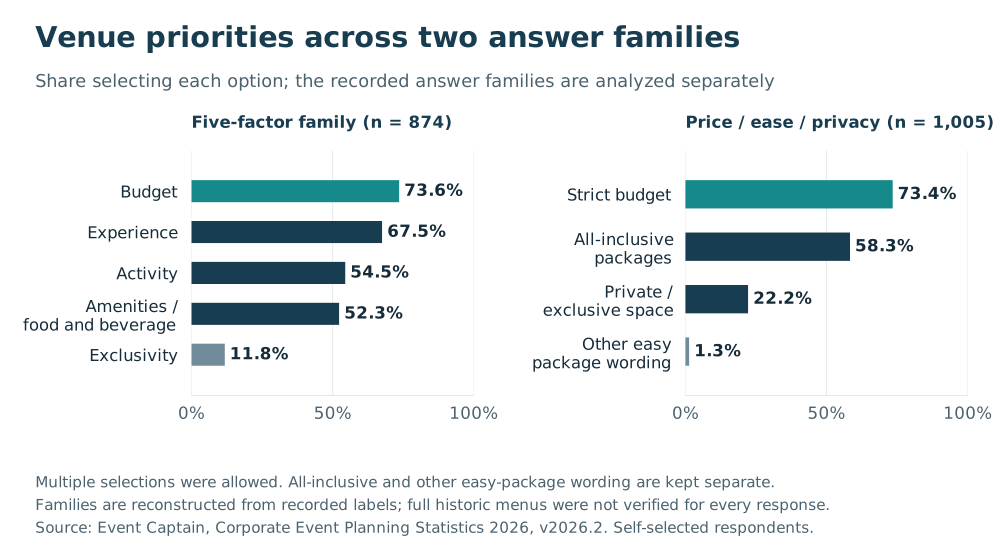
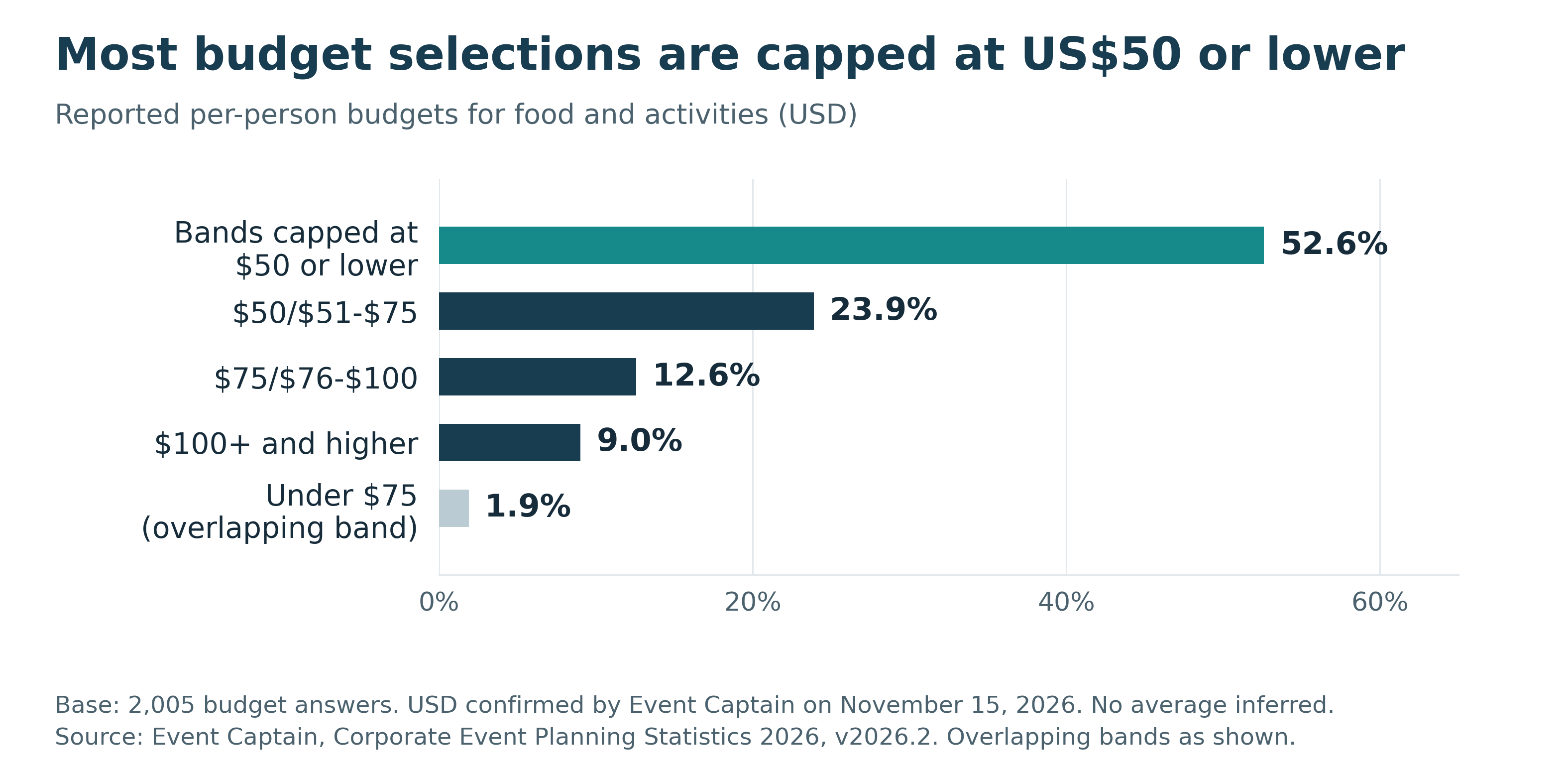
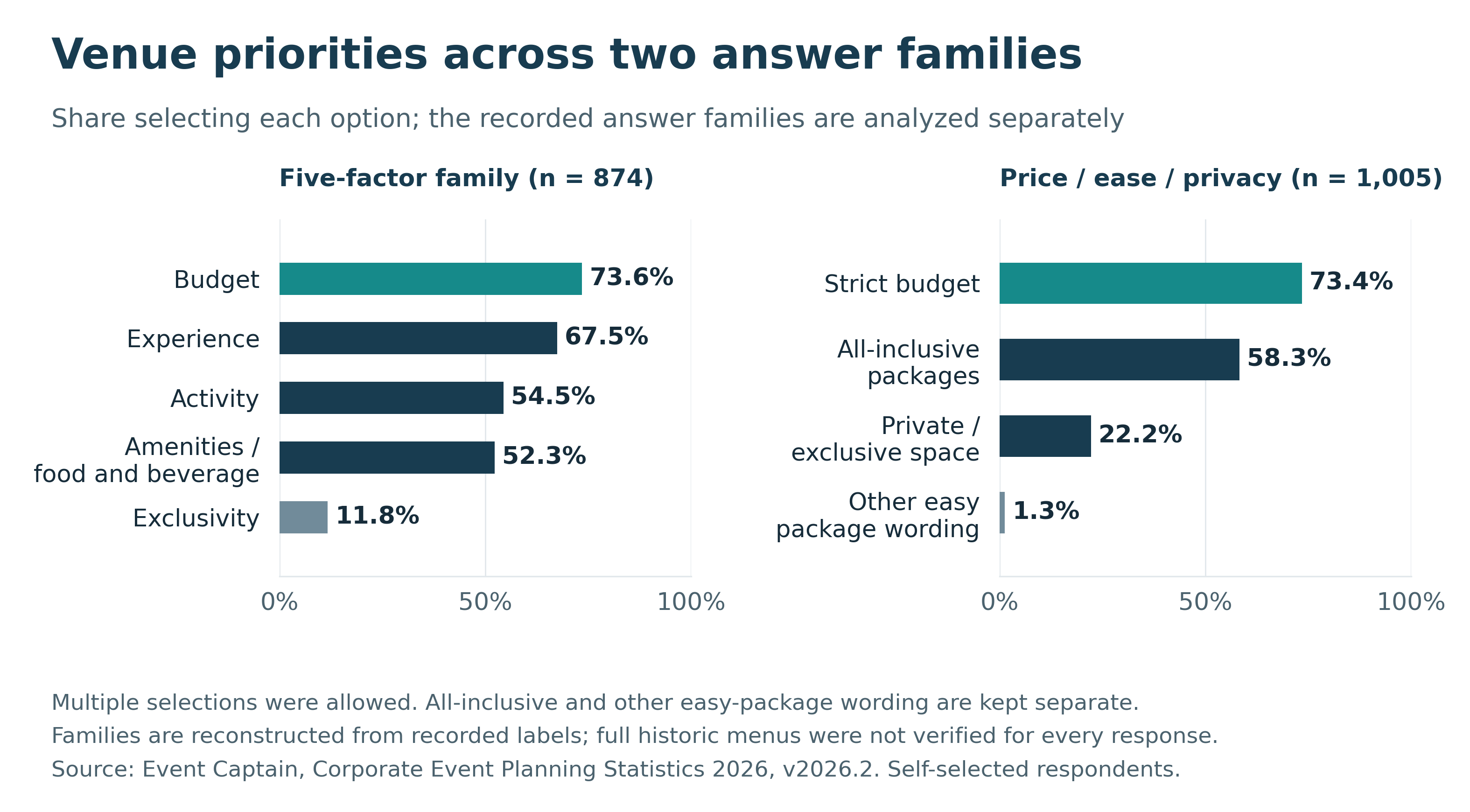
Overall, 52.6% of respondents selected per-person budget bands capped at $50 USD or less (1,055 of 2,005). That is the overall result, not a small-group budget figure. In the five-factor priority question, budget was selected by 73.6% (643 of 874) and experience by 67.5% (590 of 874). People could choose more than one factor, so both matter at once.
Give the organizer something concrete to evaluate: what guests will do, what food and service are included and what the whole arrangement costs. Ideas to test:
- A clearly scoped entry package, with optional additions explained plainly.
- A short inclusion list right beside the price.
- A sample schedule or a few relevant photos next to that list.
- Upfront treatment of taxes, gratuities, service charges, drink allowances and activity upgrades.
- A minimum spend or minimum headcount where your costs require one.
Use the reported budget ranges to understand and qualify inquiries, then cost your actual offer against food, service, activity and space. The survey does not set a profitable price or a universal package price. The question asked about a typical budget including food and activities; how tax, gratuity and service charges were treated was not established. All amounts are USD.
In the study: Budget finding Venue priorities finding
3. Make convenience available at more than one budget level
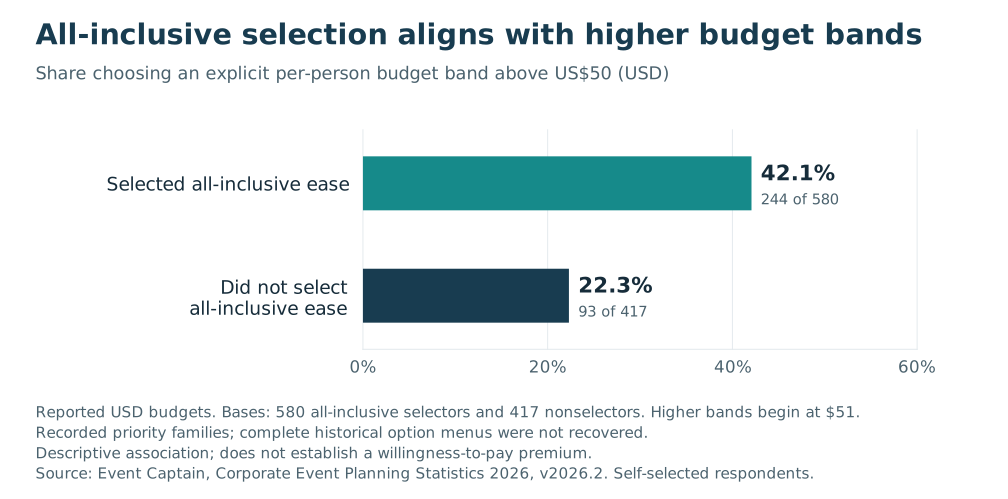
Among respondents using the same per-person budget labels, 42.1% of those who selected all-inclusive packages chose the $51–75, $76–100 or $100+ USD bands (244 of 580), compared with 22.3% of those who did not (93 of 417). But 57.9% of the same all-inclusive selectors chose the "Less than $30" or "$31–$50" bands (336 of 580). The higher-band pattern also appears within exact 1–20 groups: 42.3% of all-inclusive selectors (135 of 319) versus 20.4% of nonselectors (54 of 265), in an additional breakdown of the published data.
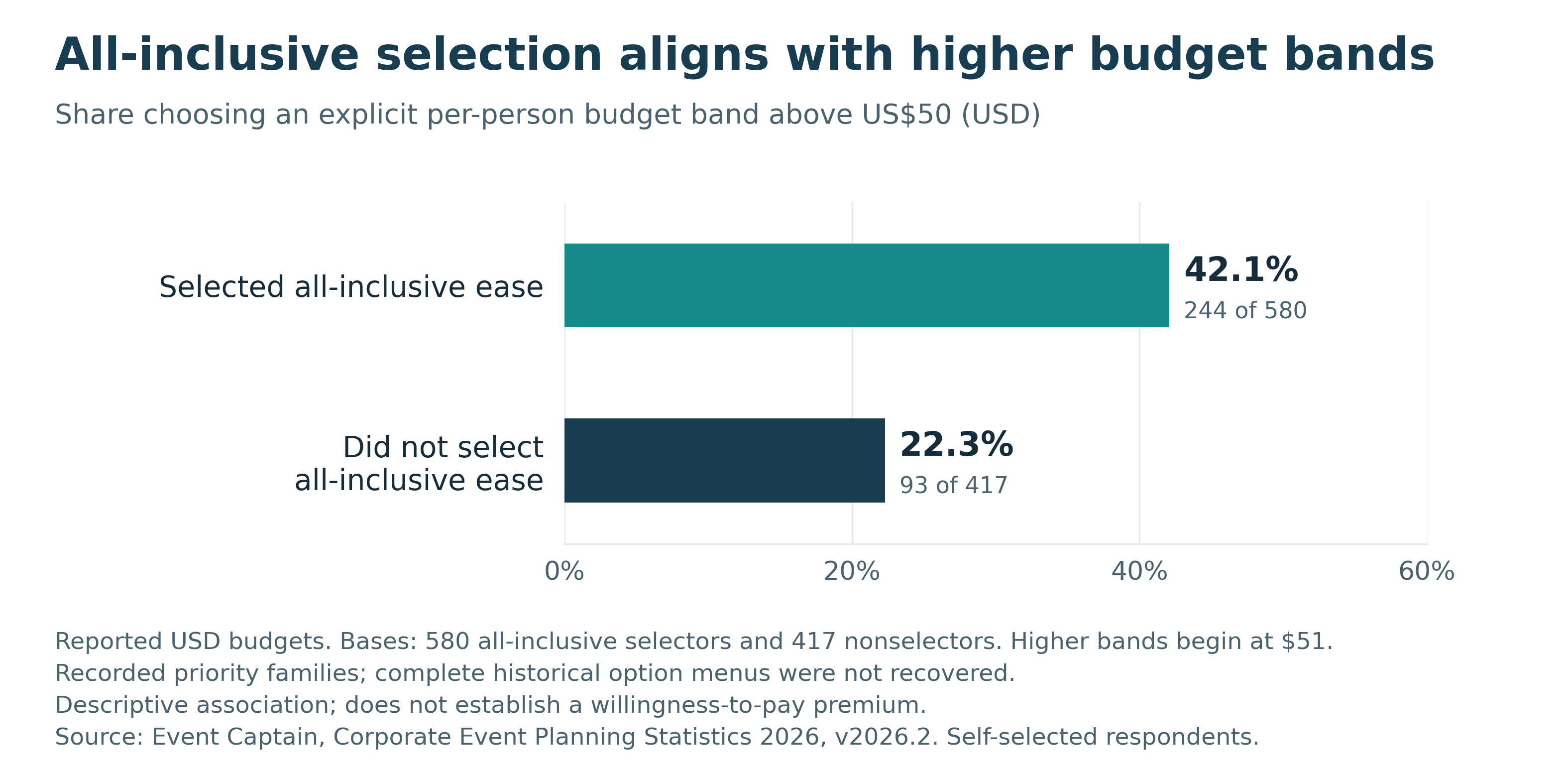
So convenience is not only a premium request. Ask separately about headcount, budget and how much the organizer wants coordinated. Offer a clearly scoped package for a modest budget, and fuller inclusions where the budget and your economics allow. A simple way to describe it: "Food, drinks and the activity arranged through one booking contact."
These comparisons describe different respondents, not what one buyer would do if offered a bundle, so do not claim that convenience makes people spend more. Useful questions to ask:
- What is the per-person budget, and what needs to fit within it?
- Would you like food, drinks and activities handled together?
- Do you need a particular service level or private space?
In the study: All-inclusive and budget finding allinclusive_budget.csv supplemental_package_budget_check.csv
4. Present private space as a specific choice
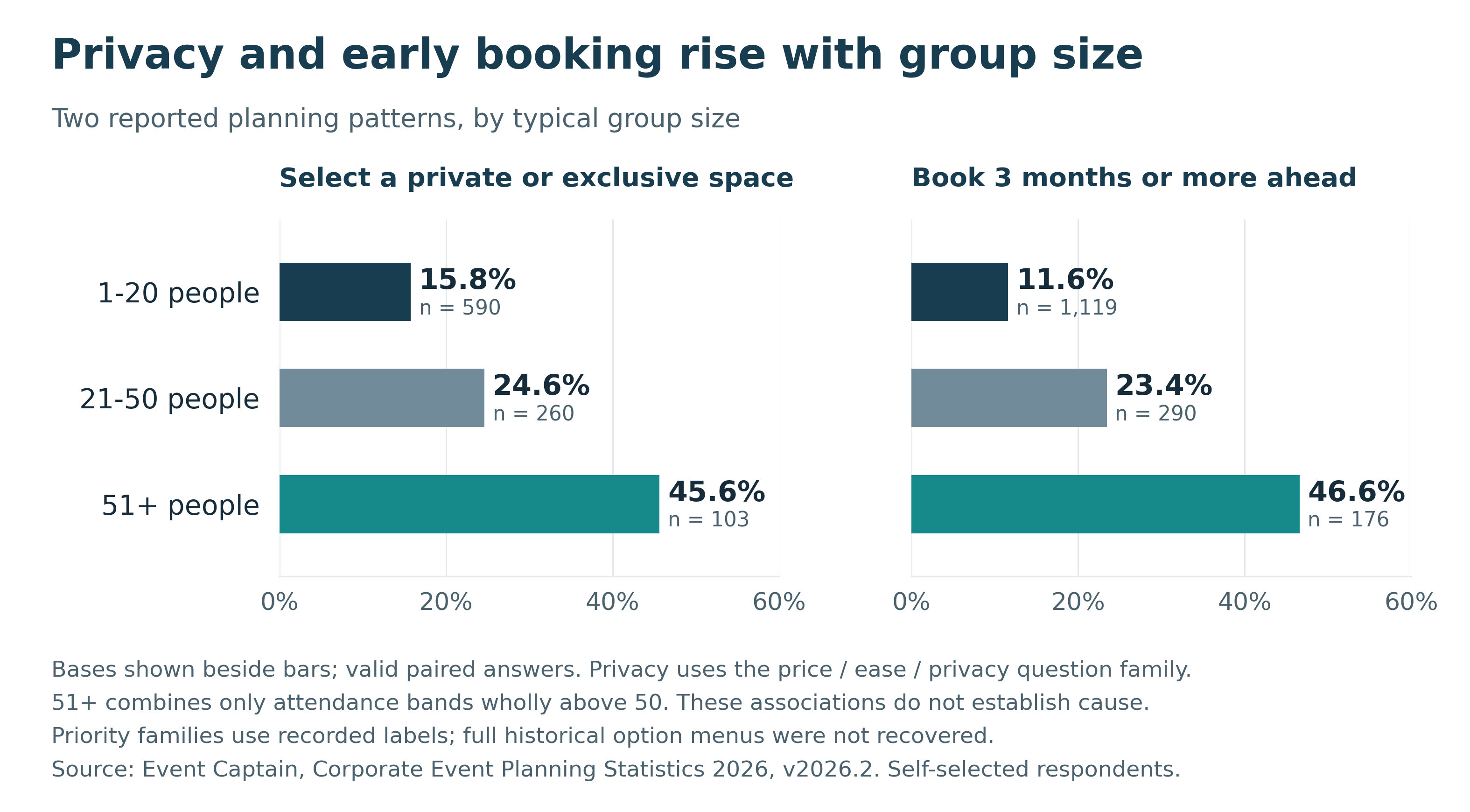
Privacy was selected by 15.8% of respondents with groups of 1–20 (93 of 590), 24.6% with groups of 21–50 (64 of 260) and 45.6% with groups clearly above 50 (47 of 103). The option covered an entire venue or a private section, so it does not mean these respondents all wanted a full buyout.
Make your space easy to understand. For larger inquiries, show the area, capacity, layout, separation and minimums early in the conversation. For smaller groups, show the options and let the organizer choose how much separation they need. Ideas to test:
- Labelled photos or floor plans of each area that can be reserved.
- A clear difference between reserved tables, a private section and exclusive use.
- Specific information about seating, activity access, sound and service.
- An honest explanation of the cost or minimum attached to each option.
Not choosing privacy is not the same as preferring shared space, and the data does not show that larger groups have larger per-person budgets.
In the study: Group-size comparisons
5. Build a planning path and a near-term booking path
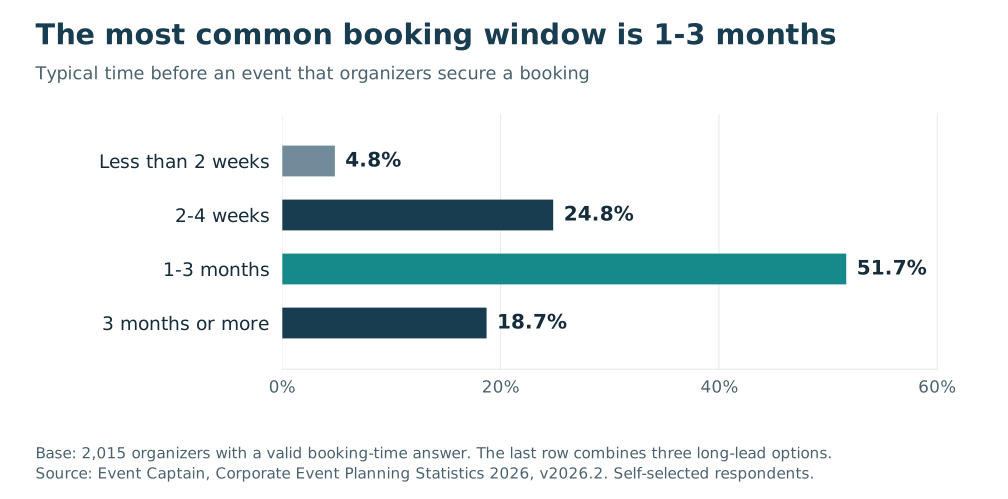
Overall, 51.7% said they typically secure bookings one to three months ahead (1,041 of 2,015) and 29.6% four weeks or less (597 of 2,015). For exact 1–20 groups, 50.8% selected one to three months (569 of 1,119), 37.5% four weeks or less (420 of 1,119) and 11.6% three months or more (130 of 1,119). For groups clearly above 50, 46.6% selected three months or more (82 of 176) and 11.4% four weeks or less (20 of 176).
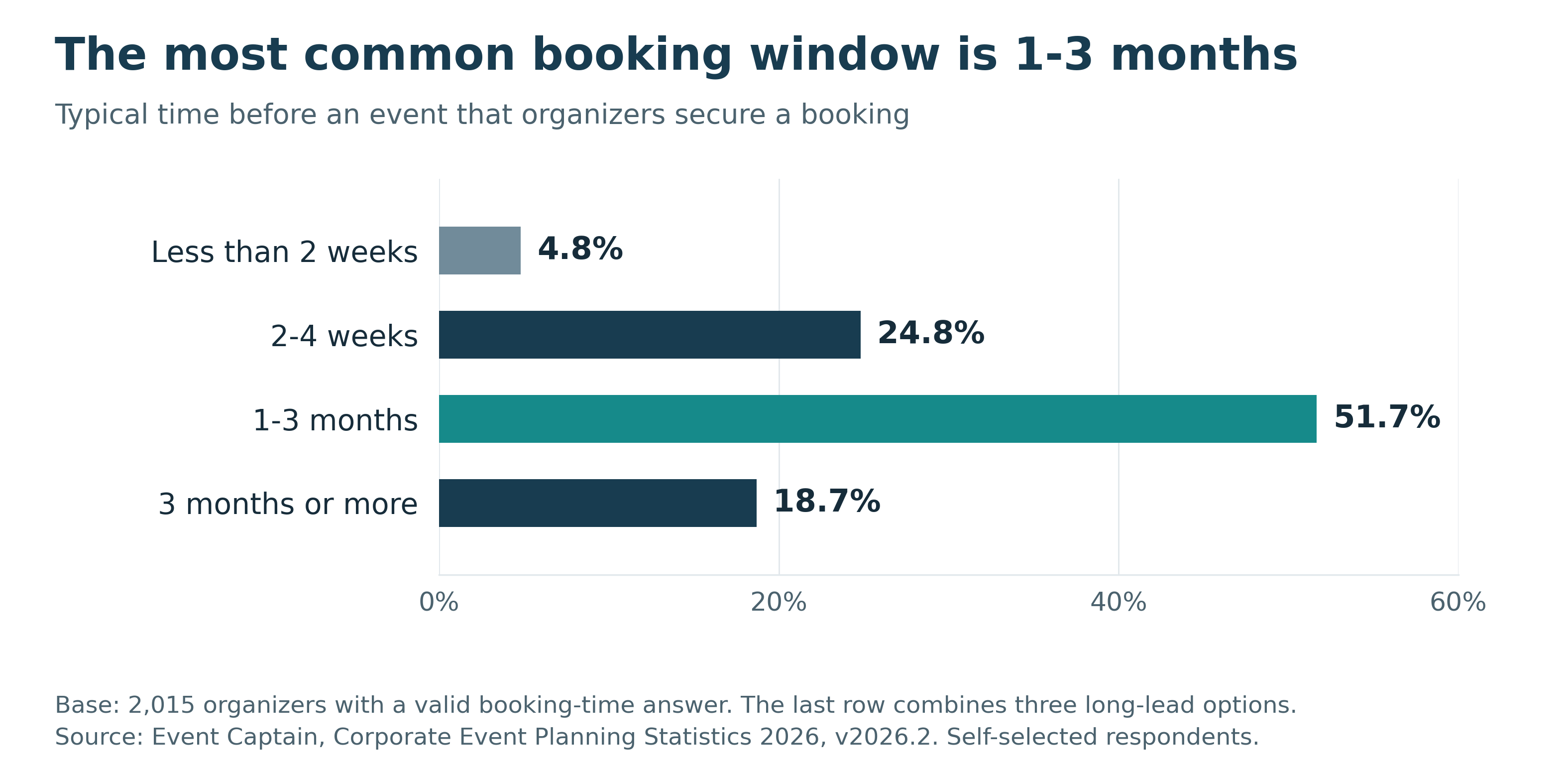
Support both advance planning and shorter-notice inquiries. Small-group marketing should serve the common one-to-three-month window and the sizeable near-term group. Larger-group sales material can start earlier conversations about space and coordination. Ideas to test:
- A stable package page that can be shared during early planning.
- A near-term availability inquiry with clear package choices and a quick quote.
- A larger-group brief covering date, headcount, space, budget and service needs.
- Follow-up timed to the organizer's stated event date, not one cadence for every inquiry.
These are reported booking windows, not when planning starts or the best time to contact someone. Do not treat small groups as last-minute buyers.
In the study: Booking lead time finding Group-size comparisons
6. Give client-hosting materials a hospitality emphasis
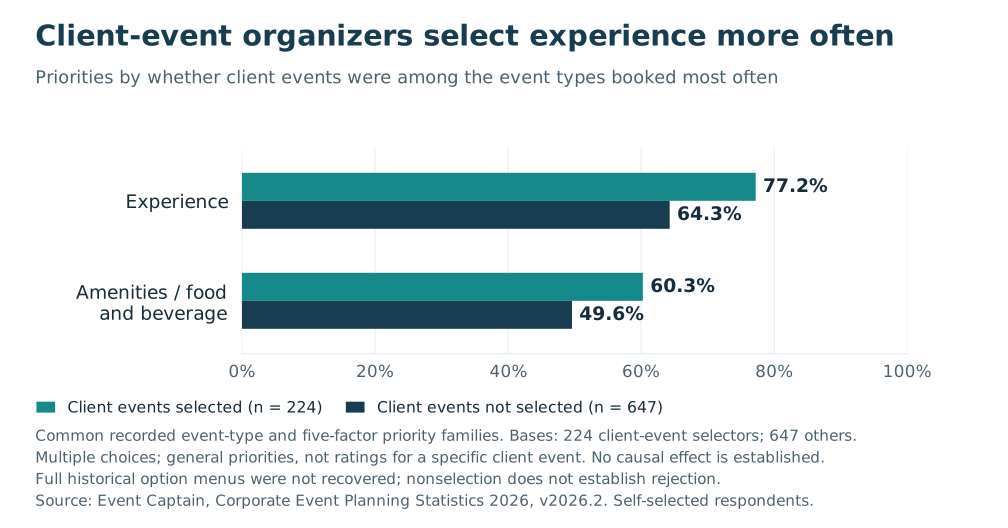
Among respondents who book client events, 77.2% selected experience as a priority (173 of 224), compared with 64.3% of other respondents (416 of 647). Amenities and food and beverage were selected by 60.3% (135 of 224) versus 49.6% (321 of 647). Budget was still selected by 74.1% of client-event organizers (166 of 224).
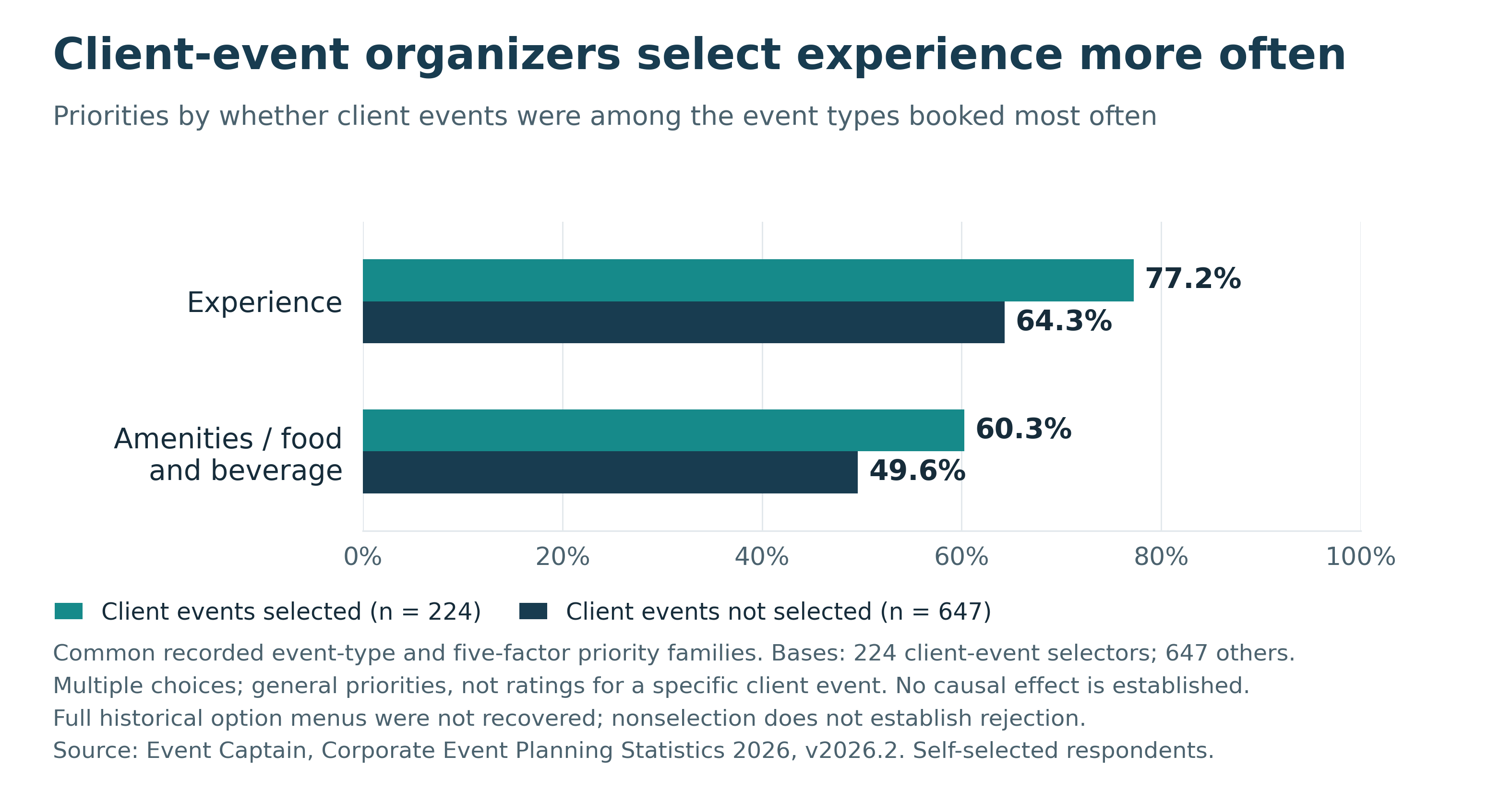
A client-hosting version of your material can lead with food, service, setting and what the guests will experience, with clear pricing alongside. Show:
- Real menus and presentation, relevant photos and the actual service arrangements.
- The seating and space setup, and whether guests can comfortably talk or take part in the activity.
- Who coordinates the event and what the host needs to do.
- Clear inclusions and an accessible price or quote structure.
Positioning to test: "A well-organized setting for hosting your clients, with the food, service and event details clearly arranged." These are general priorities among organizers who include client events in what they book. Both experience and budget were selected often, so avoid an "experience beats price" claim.
In the study: Client-event finding client_event_priorities.csv
7. Keep corporate-event information useful throughout the year
Asked which months they are most likely to book a venue, 49.8% selected October–December (1,102 of 2,215). January–March, April–June and July–September were also selected by 25.4%, 27.3% and 37.2%. People could choose more than one quarter. After excluding everyone who selected October–December, 1,113 organizers remained; among those answering each question, 59.5% still reported groups of 1–20 (605 of 1,017) and 51.4% still selected booking one to three months ahead (523 of 1,017).
Keep a useful corporate-event offer and inquiry path available all year, and point seasonal promotions to it. Team appreciation, team outings and client hosting all work as package themes, but only the survey's own event-type wording describes measured results.
The quarter results are not event dates, revenue shares or a holiday-party schedule, and they do not point to a best month to advertise.
In the study: Booking months finding October–December exclusion check
8. Qualify the inquiry around needs, then test the offer
This section is practical advice, not a new survey finding. A short inquiry form or first conversation can establish:
- Approximate headcount.
- Preferred date and flexibility.
- Event purpose, such as team appreciation or client hosting.
- Per-person budget and what it should include.
- How much food, drink and activity coordination they want.
- Whether they need reserved, shared or private space.
Those answers let you present the right package, space and planning process. Headcount alone is not enough to set the price or guess what the buyer values.
For a first test, pick a small-team offer you can deliver well, make the inclusions and total cost clear, show the actual space and use an obvious date and headcount inquiry. Track qualified inquiries, bookings, revenue, delivery costs and margin, plus the questions people keep asking. Use those results to improve the offer. The research does not promise a conversion or revenue lift.
Three package examples to adapt
These are illustrative designs, not survey-tested products or required price tiers. Adapt each to your costs, capacity and services.
- Small-Team Social. For a small company team. Make clear: supported headcount, reserved area, duration, food and activity choices, drink allocation, per-person price and minimum spend.
- Coordinated Team Experience. For an organizer who wants food, drinks and activities handled together. Make clear: exact inclusions, schedule, one point of contact, total price and available adjustments. This can work at more than one price level.
- Client Hosting. For an organizer hosting clients. Make clear: menu and service, setting, seating, guest experience, coordinator, price and private-space options.
For a restaurant, food and seating may anchor the offer. For an activity business, show the activity slot alongside food and drink. Privacy can be a clearly described option; it does not need to be in every package.
Quick checklist
- A small-team package with group range, inclusions, duration and per-person price on one page.
- Price and inclusions shown side by side, with taxes, gratuity and minimums stated upfront.
- At least one convenient, fully coordinated option at a modest budget.
- Photos or floor plans that show reserved, private and exclusive space clearly.
- An early-planning path and a near-term inquiry path.
- A client-hosting version that leads with food, service and setting.
- An offer that stays live all year, with seasonal promotions pointing to it.
- An inquiry form asking for headcount, date, purpose, budget, coordination and space.
FAQ
How big are most corporate event groups?
In Event Captain's 2026 survey, 59.2% of people who answered the attendance question selected a typical group of 1–20 (1,201 of 2,030). That describes respondents' typical events, not every event in the market.
What per-person budget do companies report for events?
52.6% selected budget bands capped at $50 USD or less per person, including food and activities (1,055 of 2,005). Use it to qualify inquiries, not as a price recommendation.
How far in advance do companies book corporate events?
51.7% said they typically secure bookings one to three months ahead, and 29.6% four weeks or less (out of 2,015). Groups clearly above 50 book earlier: 46.6% selected three months or more.
When in the year do companies book a venue?
49.8% selected October–December as a likely time to book a venue, but 25.4% to 37.2% also selected each of the other quarters. These are booking times, not event dates.
Did the survey show these ideas increase bookings?
No. The survey measured reported habits and preferences. The lessons are offers to test and measure against your own inquiries, bookings and margins.
Source
Source: Event Captain, Corporate Event Planning Statistics 2026: Budgets, Booking Timelines and Venue Preferences (edition 2026.2, analysis snapshot November 14, 2026). Survey of 2,232 respondents who plan or book events for their company or organization. Respondents were self-selected and results are unweighted. Each finding uses its own answered base, so 2,232 is not every question's denominator. All budget amounts are USD. See the methodology and the full aggregate data (CSV).