Guide
Why Organizers Choose All-Inclusive Packages
In Event Captain's 2026 survey, many organizers selected all-inclusive packages as a priority, and they did so at more than one budget level. This article looks at that preference from the planner's side. For how to build the offer, see the companion packages guide.
By Kevin Ho 5 min read
In this article
The person booking a company event is often doing that work on top of another job. They need a date, a room, food, drinks and something for the group to do, and they have to keep the cost inside a number their manager already approved.
An all-inclusive package is one response to that pressure. It is not only a premium upgrade. In Event Captain's 2026 corporate event planning study, organizers selected all-inclusive packages often, including at modest per-person budgets, and they also selected fitting a strict budget at a high rate in the same question family.
This article stays on that planner-side question: why the preference shows up, and what it is tied to in the data. For practical help building and presenting a package, see Corporate event packages: 8 lessons for restaurants and venues.
The survey recorded reported preferences. It did not test whether bundling food, drink and activities causes anyone to spend more, or whether a new package increases bookings.
Ease is a frequent priority, not a niche request
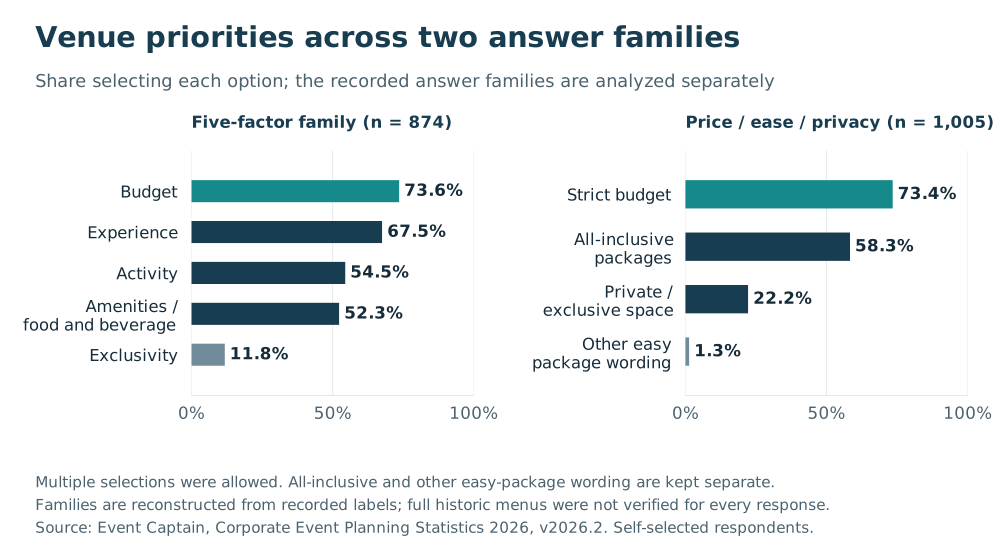
One of the study's priority questions offered a price, ease and privacy family of answers. In that family, 58.3% selected "Ease: All-inclusive packages (Food + Drink + Activities handled together)" (586 of 1,005). In the same family, 73.4% selected fitting into a strict budget (738 of 1,005).
Source: Event Captain 2026 survey
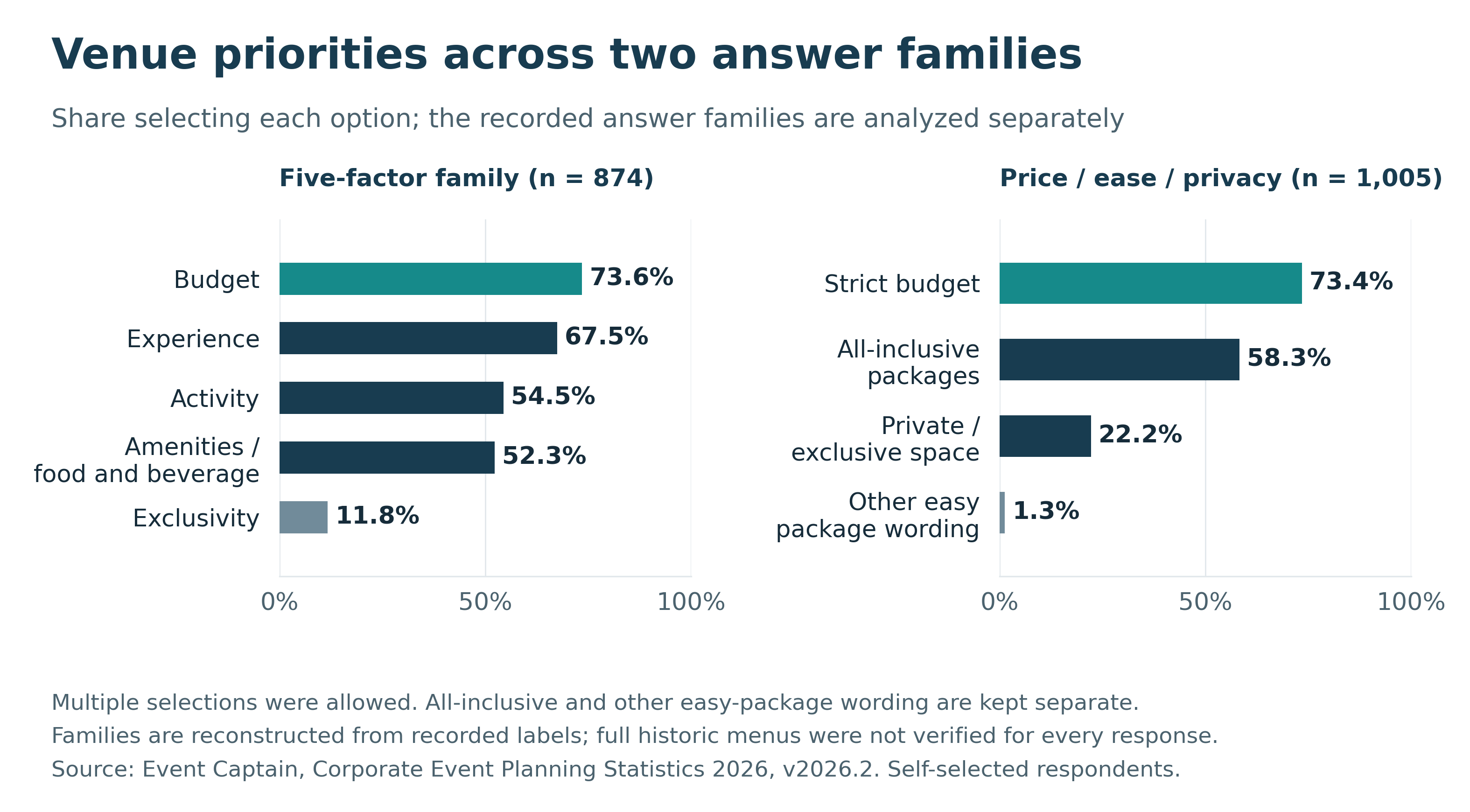
People could choose more than one option, so these figures do not mean 58.3% wanted convenience instead of a budget. A large share of this group selected a tight budget, and a large share selected an all-in package. The all-inclusive wording in the survey is specifically about having food, drink and activities handled together.
That combination is a useful way to read the organizer's job. They are often trying to stay inside a number and to avoid assembling the event from separate vendors, separate quotes and separate follow-ups.
The preference is not limited to small groups
Among exact 1–20-person respondents in that same question family, 54.9% selected all-inclusive packages (324 of 590). The share was also high in larger exact bands: 63.8% of exact 21–50 groups (166 of 260) and 56.3% of clearly 51+ groups (58 of 103).
Source: Event Captain 2026 survey
A small-team outing is a natural fit for a single package, and small groups were the most common typical size in the study: 59.2% selected 1–20 people (1,201 of 2,030). But the all-inclusive selection does not drop away as groups get larger. If you only attach a bundled offer to your smallest package, you may miss organizers bringing 30 or 80 guests who also want one person handling the moving parts.
Source: Event Captain 2026 survey
All-inclusive selectors reported higher budgets more often, and many still stayed at $50 or less
The study compared per-person budget bands among people who did or did not select all-inclusive packages, using matched explicit budget labels.
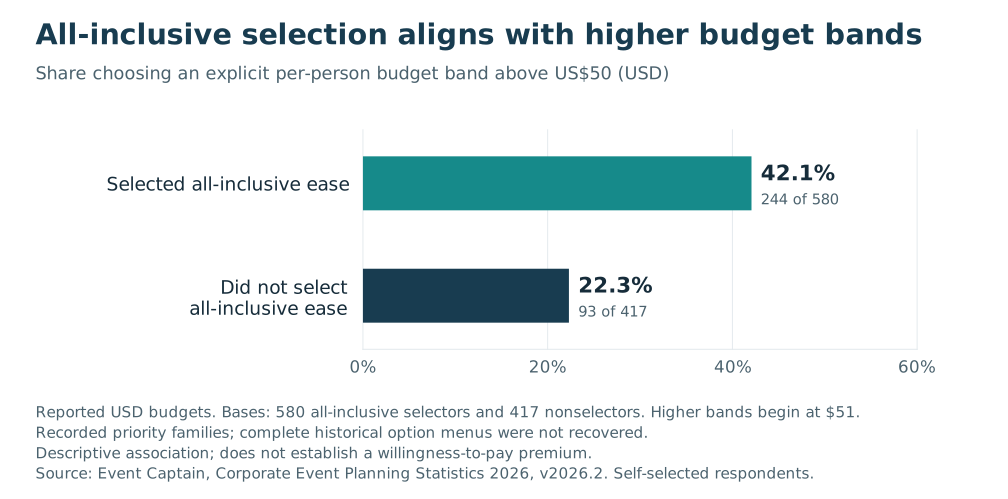
42.1% of all-inclusive selectors chose the $51–75, $76–100 or $100+ USD bands (244 of 580), compared with 22.3% of nonselectors (93 of 417).
Source: Event Captain 2026 survey
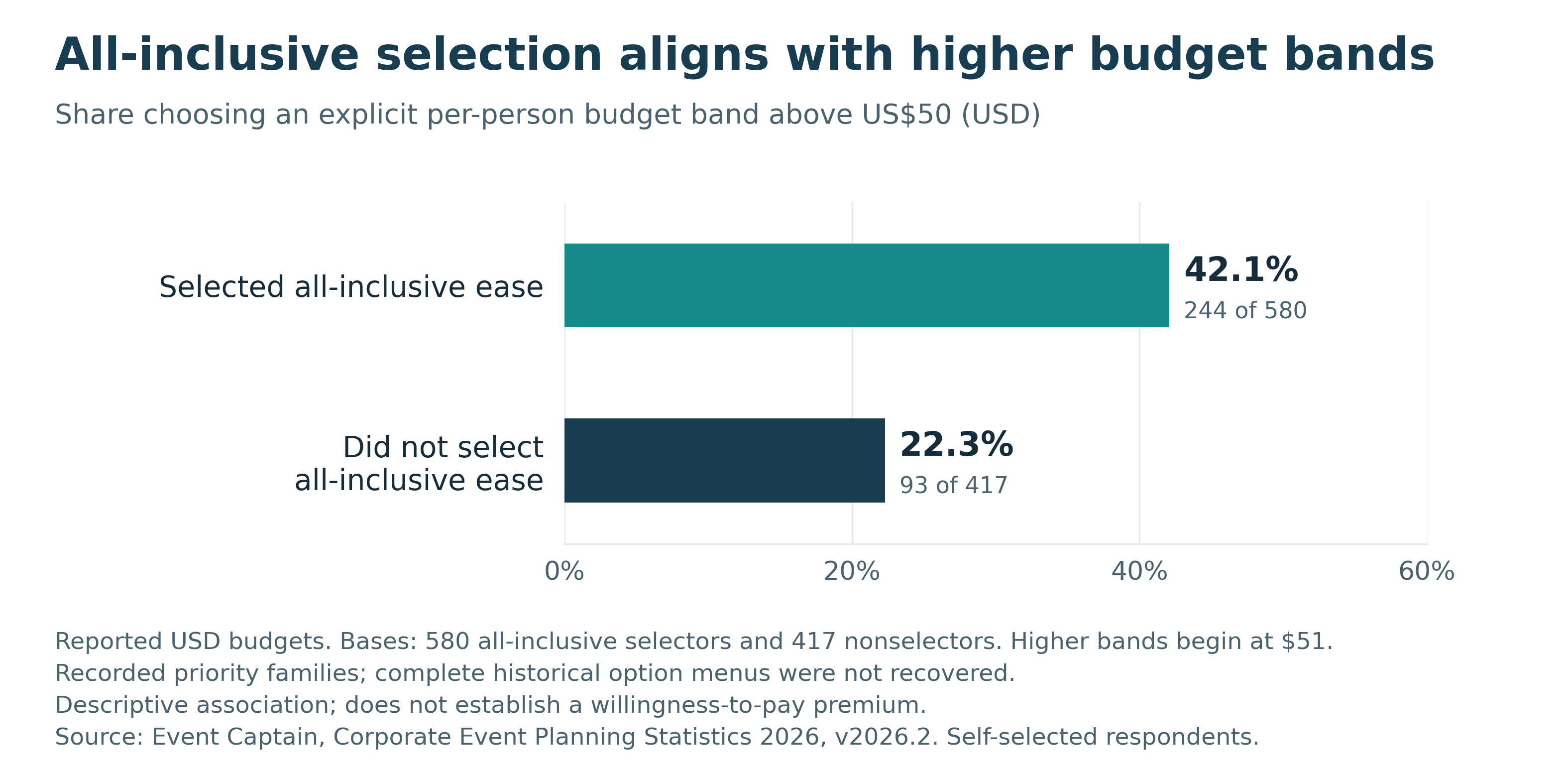
That is only one side of the same table. In that all-inclusive group, 57.9% selected the "Less than $30" or "$31–$50" bands (336 of 580). Within those selectors, the published explicit bands were:
- Less than $30 per person: 134 of 580 (23.1%)
- $31–$50 per person: 202 of 580 (34.8%)
- $51–$75 per person: 141 of 580 (24.3%)
- $76–$100 per person: 75 of 580 (12.9%)
- $100+ per person: 28 of 580 (4.8%)
Source: Event Captain 2026 survey
The higher-band pattern also appears inside exact 1–20-person groups: 42.3% of all-inclusive selectors chose the higher bands (135 of 319), compared with 20.4% of nonselectors (54 of 265). The study notes that the direction also persists when Q4 venue-booking respondents are excluded.
Source: Event Captain 2026 survey
Two limits matter here. First, these figures compare different people. They do not show that offering a bundle raises anyone's budget. Second, not selecting all-inclusive does not mean a person rejected a package you offered. It only means they did not choose that option in the survey.
The honest reading is narrower, and still useful. Organizers who wanted food, drink and activities handled together showed up in every published budget band. Many of them described a modest per-person budget. Some described a higher one. Convenience is not only a request from the top of the range.
For the overall budget distribution, including the 52.6% of all budget respondents who selected bands capped at $50 USD or less (1,055 of 2,005), see Corporate event budgets per person in 2026.
Source: Event Captain 2026 survey
What this means when you talk to an organizer
If the planner's goal is a clear budget and fewer moving parts, the conversation should start with those two points, not with a long menu of à la carte choices.
Questions that follow from the data, and were not tested in the survey:
- What is the per-person budget, and what needs to fit inside it?
- Would you like food, drinks and activities handled together?
- Do you need a particular service level or a private space?
A simple way to describe the offer, also untested in the survey: "Food, drinks and the activity, arranged through one booking contact."
Then have more than one version of that offer. The data supports testing a clearly scoped package at a modest price and a fuller one where the budget and your margins allow. How to structure, price and present those packages is the job of the packages guide, which turns the same study into eight tests for restaurants and venues.
FAQ
### How many organizers want an all-inclusive package?
In the study's price, ease and privacy question family, 58.3% selected all-inclusive packages (586 of 1,005). People could choose more than one factor in that family.
Source: Event Captain 2026 survey
Is this mainly because they have a higher budget?
Not mainly. All-inclusive selectors chose higher budget bands more often (42.1% versus 22.3%), but 57.9% of them still selected $50 USD or less per person. The comparison is observational.
Source: Event Captain 2026 survey
Do small groups want packages more than large groups?
All-inclusive packages were commonly selected in every size band in this sample, including 54.9% of exact 1–20 groups (324 of 590), 63.8% of exact 21–50 groups (166 of 260) and 56.3% of clearly 51+ groups (58 of 103).
Source: Event Captain 2026 survey
Does offering an all-inclusive package make people spend more?
The survey does not show that. It compares the budgets reported by different groups of respondents, and it is not a pricing experiment.
Where should venues look for help building a package?
See Corporate event packages: 8 lessons for restaurants and venues, which is the practical companion to this article.
Source
Source: Event Captain, Corporate Event Planning Statistics 2026: Budgets, Booking Timelines and Venue Preferences (edition 2026.2, analysis snapshot November 14, 2026). Survey of 2,232 respondents who plan or book events for their company or organization. Respondents were self-selected and results are unweighted. Each finding uses its own answered base, so 2,232 is not every question's denominator. All budget amounts are USD. See the methodology and the full aggregate data (CSV).